
Introduction
“I want to learn the Quran, but I have no time.” This is the sentence that every Quran teacher hears most often. Work, family, children, cooking, travel, and a hundred small tasks fill the day, and by the evening there is no time left. The Quran waits, and the weeks turn into months, and the months turn into years.
The truth is that almost everyone has time for the Quran: not an hour a day, but fifteen minutes. The secret is not finding time, but making time, and making it a habit. This guide shows how to make time for Quran learning every day, with small steps that fit into any life.
Why small daily steps work
Many people think that learning the Quran needs long hours of study. It does not. Fifteen minutes every day is better than two hours once a week, because daily practice keeps the learning fresh. A student who reads a few verses every day will remember them. A student who reads for two hours on Sunday and nothing for the rest of the week will forget most of it by the next Sunday.
Small steps also build a habit. When you do something at the same time every day, it becomes part of your routine, like brushing your teeth or eating breakfast. After a few weeks, you no longer need to remind yourself: the time is already set aside, and the Quran is already open.
A habit of fifteen minutes a day adds up. Fifteen minutes a day is more than ninety hours in a year. In ninety hours, a beginner can finish Noorani Qaida and start reading the Quran. A reader can finish a full Juz. A student of Tajweed can learn the main rules. Small steps, taken daily, lead to great results.
Find your best time of day
Everyone has a time of day when they learn best. For many people, it is the early morning, before the house wakes up. The mind is fresh, the house is quiet, and the day has not yet begun. The Prophet Muhammad, peace be upon him, prayed for blessing in the early morning, and many students find that the morning is the best time for the Quran.
For others, the best time is after Fajr prayer, when the heart is already turned towards Allah. For a mother, it may be the middle of the day, when the children are at school. For a worker, it may be the evening, after dinner, when the day’s work is done.
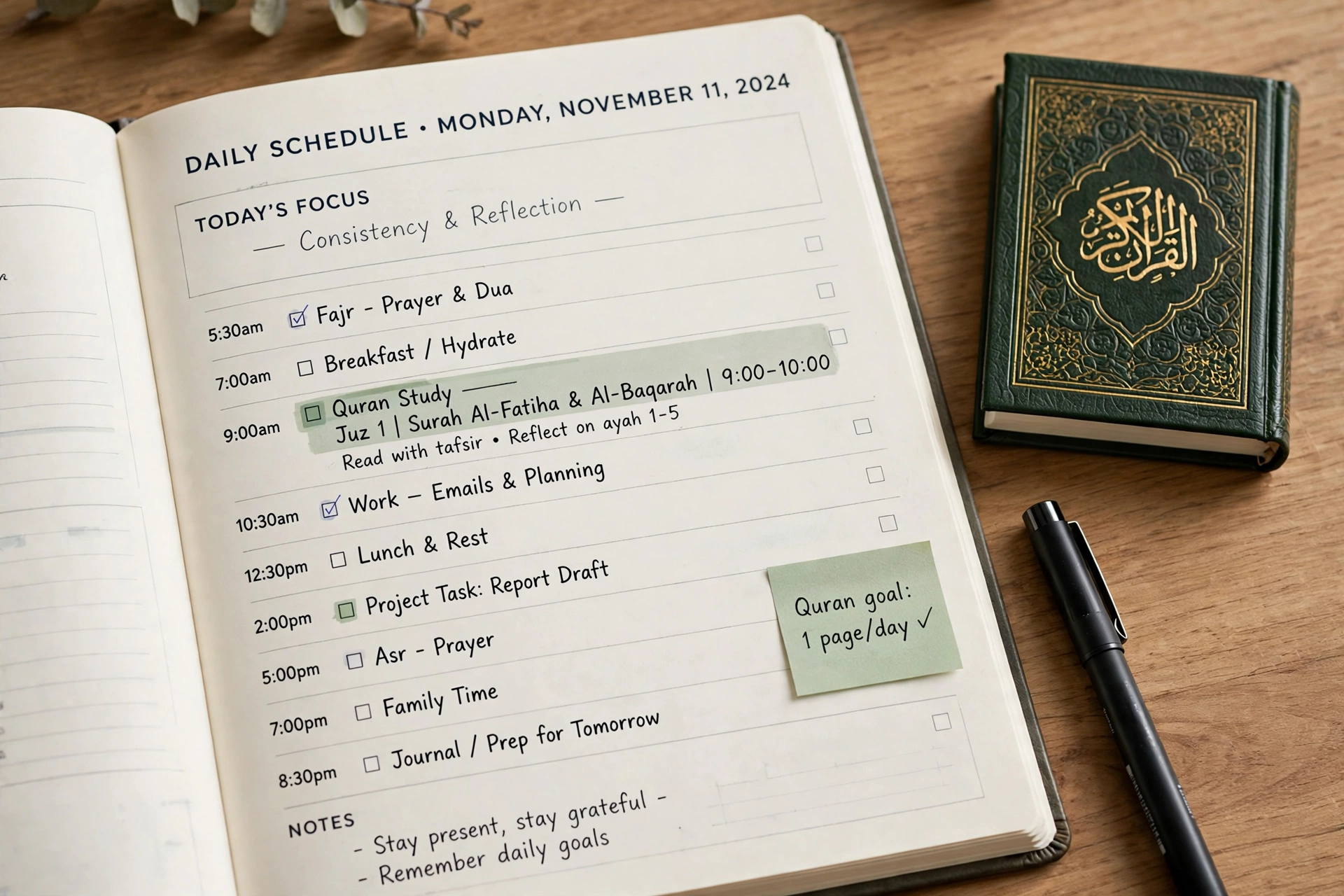
There is no single right time. The right time is the time that works for you, every day. Choose a time, and keep it fixed. Tell your family that this is your Quran time, and ask them not to disturb you. A fixed time, kept daily, is the foundation of a habit.
Start with fifteen minutes
Do not begin with an hour. Begin with fifteen minutes. Fifteen minutes is short enough that no one can say they have no time for it, and long enough to read a few verses, practise a lesson, or revise what you learned.
In your fifteen minutes, do one thing well. Read a few verses slowly, with correct pronunciation. Or practise the letters your tutor corrected. Or listen to a reciter and follow along. Do not try to do everything at once. One small task, done well, is better than a long session done badly.
When fifteen minutes becomes easy, you can add five more minutes. Many students find that once they start, they want to continue, and fifteen minutes becomes twenty, then thirty. But the rule is simple: never skip a day because you cannot find an hour. Fifteen minutes is enough, and it is always possible.

Donate Now
Use the waiting moments
Much of the day is spent waiting: waiting for a bus, waiting in a queue, waiting for food to cook, waiting for a child to finish school. These waiting moments are wasted time, but they can become Quran time.
Keep a small copy of the Quran, or a Quran app, on your phone. When you are waiting, open it and read a few verses. Listen to a recitation on your headphones while you travel. Repeat a verse you are memorising while you walk. These small moments add up: ten minutes here, ten minutes there, and by the end of the day you have studied for half an hour without ever sitting down to study.
A student who uses waiting moments will learn faster than a student who only studies at a desk. The Quran is not only a book for the study room: it is a book for the whole day, and it fits into the gaps of life.

Make it a family habit
Learning alone is hard. Learning together is easier. Make Quran learning a family habit: a fixed time every day when the family reads together, or when each person reads on their own, in the same room. A child who sees their parents reading the Quran every day will want to read too.
A family can read together after Fajr, or after dinner, or before bed. Even ten minutes together, every day, will change the atmosphere of the home. The Quran becomes a part of family life, not a task that one person does alone.
Parents can also help each other: a husband and wife can take turns watching the children, so that each of them has fifteen minutes of quiet time for the Quran. A mother can practise with her daughter. A father can listen to his son’s recitation. When the whole family learns, no one is left behind.

Track your progress and stay motivated
Motivation fades, but progress keeps it alive. Keep a simple record of what you learn: the pages you read, the verses you memorised, the rules you mastered. When you look back after a month, and see how far you have come, you will want to continue.
Set small goals: finish Noorani Qaida in three months, read one Juz in a month, memorise one short Surah in a week. When you reach a goal, celebrate it, and set the next one. Small goals, reached one by one, lead to great achievements.
If you miss a day, do not give up. Missing one day is not failure: it is life. The next day, start again. The student who misses a day and returns is stronger than the student who never misses a day, because they have learned to begin again.
A tutor also helps with motivation. A lesson every week, with a tutor who is waiting for you, keeps you accountable. At Madina Quran, our tutors keep a record of every student’s progress, and they encourage the student at every step.
A Hadith to remember
The Prophet Muhammad, peace be upon him, said: “There are two blessings which many people lose: health and free time.” (Sahih al-Bukhari)
This hadith is a warning and a reminder. Health and free time are blessings from Allah, and many people lose them without noticing: they spend their health on things that do not matter, and they spend their free time on things that do not last. The Quran is the best use of free time, and the best investment of the hours that Allah has given us. Use your free time before it is gone, and give the Quran its place in your day.
Learn with a tutor to stay on track
A fixed lesson with a tutor is one of the best ways to make time for the Quran. When a lesson is booked, the time is already set aside, and the student must be ready. The tutor gives homework, and the student practises between lessons. This structure turns good intentions into real progress.
At Madina Quran, our classes are one to one, online, at a time that suits you. Our tutors are qualified and experienced, and they teach children, teenagers and adults, at every level, from complete beginners to advanced readers. You can learn from home, in a safe and secure environment, with a certificate provided on completion.
To enrol or to ask any question, contact Madina Quran on WhatsApp, IMO or Skype at +923006264166. Learn anywhere, anytime, and start your Quran journey now.
Support Madrasa Anas Bin Malik
Madrasa Anas Bin Malik needs your support. Your donation helps the madrasa teach the Quran to children and adults. To donate, or to ask how your donation will be used, contact Madina Quran on WhatsApp, IMO or Skype at +923006264166.
You can donate through PayPal at vehari566@gmail.com, or by scanning the QR code below to donate through the TRC20 wallet. Every donation is voluntary, and keeping your payment receipt is a good idea. To learn more about the madrasa and how donations are used, visit the Donate page on this site. Thank you for supporting Quran education.
Donate Now
Conclusion
Making time for Quran learning is not about finding an empty hour in a busy day. It is about fifteen minutes, taken daily, at a fixed time, in the gaps of life, with the family, and with a tutor who keeps you on track. Small steps, taken every day, lead to great results, and the reward for learning the Quran is greater than any other use of your time. Start today, with fifteen minutes, and keep going.
Frequently asked questions
How much time do I need to learn the Quran every day?
Fifteen minutes a day is enough to make real progress. Fifteen minutes daily is better than two hours once a week, because daily practice keeps the learning fresh.
What is the best time of day to learn the Quran?
The best time is the time that works for you, every day. Many people prefer the early morning, or after Fajr prayer, when the mind is fresh and the house is quiet. Choose a fixed time and keep it.
How can I find time when my day is so busy?
Use the waiting moments: read a few verses while travelling, waiting in a queue, or waiting for food to cook. Keep a Quran app on your phone, and turn wasted minutes into learning time.
What if I miss a day?
Missing one day is not failure. Start again the next day. The student who misses a day and returns is stronger than the student who never misses a day.
Does learning with a tutor help me make time?
Yes. A fixed lesson with a tutor sets the time aside, gives you homework, and keeps you accountable. At Madina Quran, classes are one to one, online, at a time that suits you.