Introduction
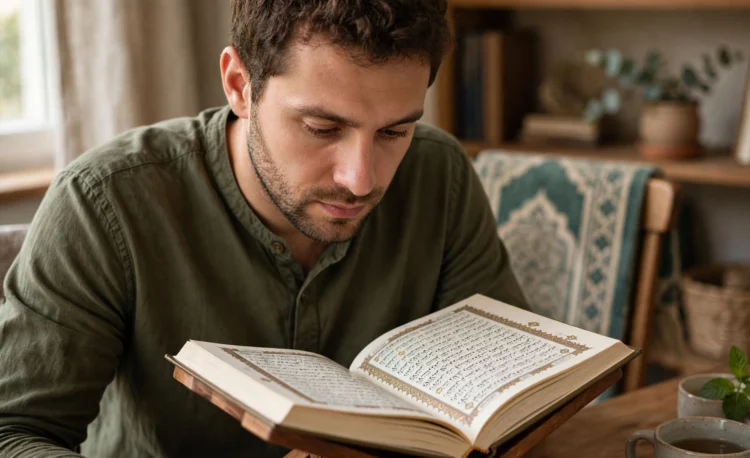
Many Muslims can read the Quran, but they want to read it better: with correct pronunciation, with beautiful sound, and with the confidence that they are reciting the words of Allah as they were revealed. Improving your recitation is a journey, and it does not happen in a day. But with the right method, daily practice, and a good teacher, every learner can improve.
This guide gives practical tips to improve your Quran recitation, whether you are a beginner or a reader who wants to polish what you already know.
Learn the letters correctly first
Good recitation starts with the letters. Each Arabic letter has a place in the mouth or throat where it is pronounced, called its Makhraj. If the Makhraj is wrong, the letter changes, and the meaning of the word can change too.
Spend time on the letters that are often confused, such as the different forms of H, the emphatic letters, and the letters that have no equivalent in English. Practise each letter on its own, then in words, then in verses. A qualified tutor can hear what you cannot hear yourself, and can correct your pronunciation before a mistake becomes a habit.
At Madina Quran, our tutors teach the letters with patience, one by one, until the student is confident. Our classes are one to one, so the tutor’s full attention is on you, and every mistake is corrected gently, at once.
Practise a little every day
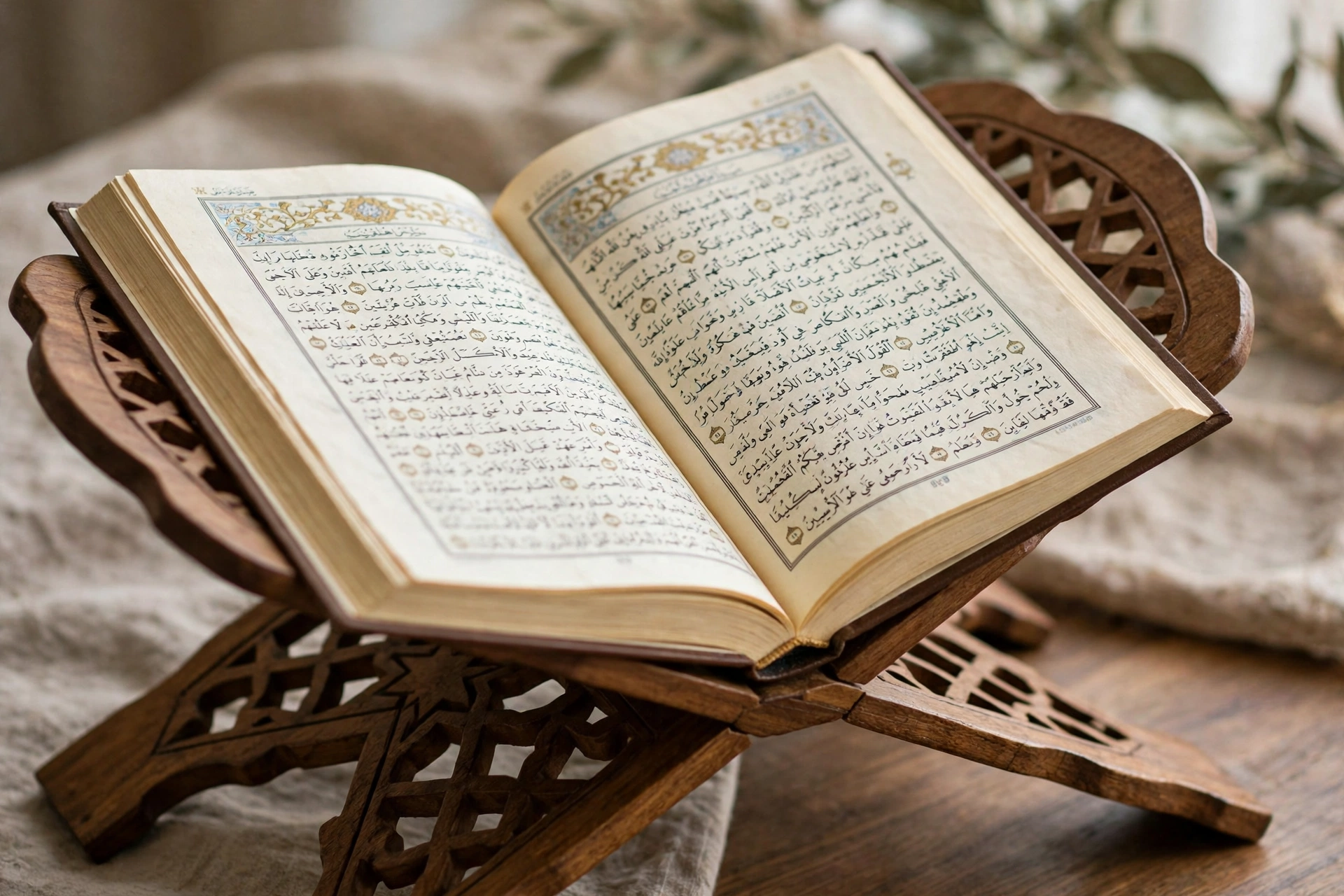
Regular practice matters more than long practice. Fifteen minutes every day is better than two hours once a week. Short, daily practice keeps the sounds fresh in your mind, and it builds a habit that lasts.
Choose a fixed time for practice, and keep it. Read a few verses slowly, listening to yourself, and repeat any verse that is difficult. Do not rush through the pages. It is better to read one page well than ten pages badly.
Keep a notebook of the mistakes your tutor corrects, and practise those words before the next lesson. Progress in recitation is often slow, but it is steady: a student who practises daily will notice a real difference within a few weeks.
Listen to good reciters
Listening is one of the best ways to improve. Listen to a reciter whose style you like, and follow along in your copy of the Quran. Listen to how the reciter pauses, where the voice rises and falls, and how each letter is pronounced.
Listen to the same verses again and again, until you can recite them in the same way. Then try to recite without listening, and compare. This is how children learn to recite beautifully, and it works for adults too.
Choose reciters who are known for correct Tajweed, not only for a beautiful voice. A beautiful voice without correct Tajweed is not good recitation. At Madina Quran, our tutors can recommend reciters to listen to, at your level.

Donate Now
Learn Tajweed step by step
Tajweed is the set of rules that govern how the Quran is recited: how long to stretch a sound, when to merge two letters, when to pause, and how to pronounce each letter. Learning Tajweed can feel difficult at first, because there are many rules. The secret is to learn them one at a time, and to practise each rule until it becomes natural.
Start with the most important rules: the correct pronunciation of the letters, the rules of Noon and Meem, the rules of Madd, which is the stretching of sounds, and the rules of stopping and starting. Do not try to learn all the rules at once. Learn one rule, practise it in your daily reading, and move on when you are ready.
Our Tajweed course at Madina Quran teaches the rules step by step, with examples from the Quran, and with plenty of practice in every lesson. Students learn at their own pace, and no one is rushed.
Record yourself and listen back
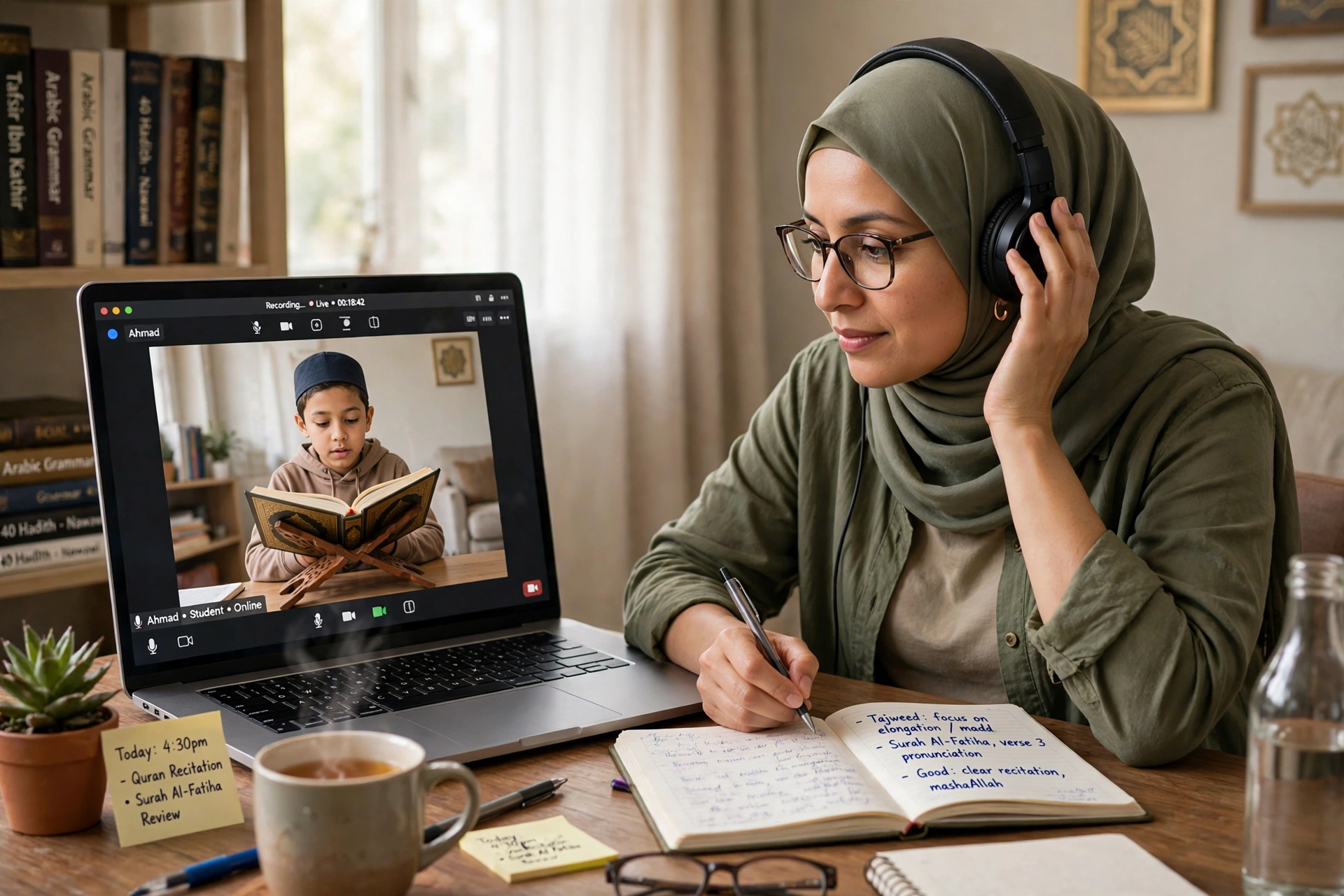
Recording yourself is a powerful tool. Most learners are surprised when they hear their own recitation, because they hear mistakes they did not notice while reading. Record a few verses on your phone, listen back, and note what needs work. Then record the same verses again after a week of practice, and hear the improvement.
Share your recordings with your tutor. A tutor can hear what you cannot, and can give you specific advice: this letter needs work, this stretch is too long, this pause is in the wrong place. Specific feedback is far more useful than general praise.
A Hadith to remember
The Prophet Muhammad, peace be upon him, said: “Beautify the Quran with your voices.” (Sunan Abi Dawud)
This hadith reminds us that recitation is not only about correctness, but also about beauty. Allah gave us voices, and we should use them to make the recitation of His words beautiful. A beautiful recitation touches the heart, and it makes the listener want to hear more. Learn the rules, practise daily, and let your voice carry the beauty of the Quran.
Learn with a tutor, not alone
It is possible to learn recitation from books and recordings, but a tutor makes the journey faster and surer. A tutor hears your mistakes, corrects them at once, answers your questions, and keeps you motivated. A tutor also keeps you accountable: a lesson every week, with homework in between, is a structure that most learners need.
At Madina Quran, our classes are one to one, online, at a time that suits you. Our tutors are qualified and experienced, and they teach children, teenagers and adults, at every level, from complete beginners to advanced readers. You can learn from home, in a safe and secure environment, with a certificate provided on completion.
To enrol or to ask any question, contact Madina Quran on WhatsApp, IMO or Skype at +923006264166. Learn anywhere, anytime, and start your Quran journey now.
Support Madrasa Anas Bin Malik
Madrasa Anas Bin Malik needs your support. Your donation helps the madrasa teach the Quran to children and adults. To donate, or to ask how your donation will be used, contact Madina Quran on WhatsApp, IMO or Skype at +923006264166.
You can donate through PayPal at vehari566@gmail.com, or by scanning the QR code below to donate through the TRC20 wallet. Every donation is voluntary, and keeping your payment receipt is a good idea. To learn more about the madrasa and how donations are used, visit the Donate page on this site. Thank you for supporting Quran education.
Donate Now
Conclusion
Improving your Quran recitation is a journey of small steps: correct letters, daily practice, listening to good reciters, learning Tajweed one rule at a time, recording yourself, and learning with a qualified tutor. Be patient with yourself, practise every day, and trust the process. Your recitation will improve, and with it, your connection to the Quran will grow deeper.
Frequently asked questions
How can I improve my Quran recitation?
Learn the letters correctly, practise a little every day, listen to good reciters, learn Tajweed step by step, record yourself, and learn with a qualified tutor.
How long does it take to improve Quran recitation?
It depends on your starting level and how much you practise. A student who practises daily will notice a real difference within a few weeks, and steady improvement over months.
Do I need a tutor to learn Quran recitation?
A tutor makes the journey faster and surer, because a tutor hears your mistakes, corrects them at once, and keeps you motivated. At Madina Quran, classes are one to one, online, at a time that suits you.
What is Tajweed?
Tajweed is the set of rules that govern how the Quran is recited: how long to stretch a sound, when to merge two letters, when to pause, and how to pronounce each letter correctly.
Can adults learn to recite the Quran well?
Yes. Adults of any age can learn and improve their recitation, with regular practice and a good tutor. It is never too late to start.